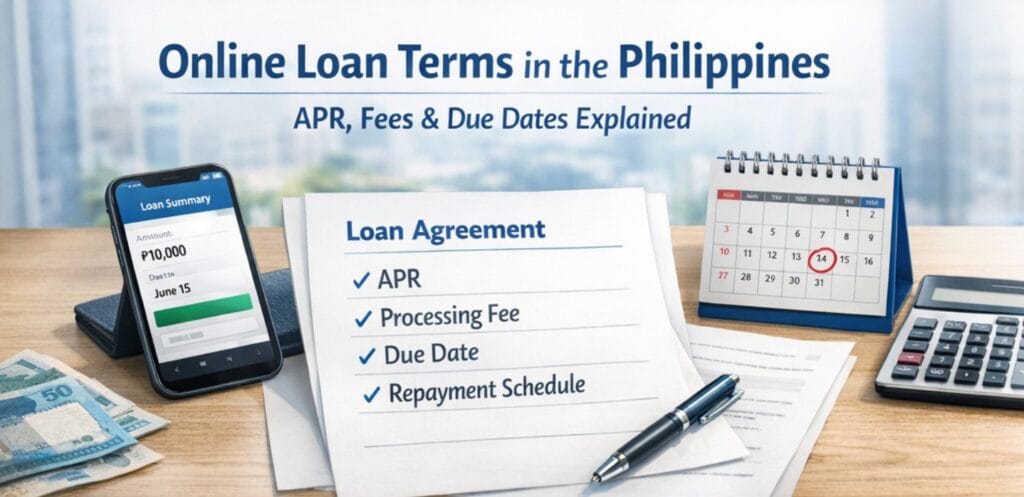
Understanding online loan terms is one of the smartest things you can do before borrowing money in the Philippines. Many borrowers focus only on fast approval or instant cash, but the real cost of a loan often depends on details such as APR, processing fees, repayment schedules, and penalty charges.
If you do not understand these terms, you could end up borrowing more than you can comfortably repay — or accepting a loan that is much more expensive than it first appears.
In this guide, we explain the most important online loan terms in the Philippines in simple language, so you can compare offers more confidently and avoid common mistakes.
Quick takeaway: Before accepting any online loan, always check the total amount you will actually receive, the full repayment schedule, all fees, and the penalties for late payment.
Why understanding loan terms matters before you apply
Online loans in the Philippines are popular because they are fast, convenient, and easy to access through mobile apps or websites. However, convenience can also make it easier to overlook important details.
Many borrowers make decisions based only on:
- “Fast approval”
- “Cash in minutes”
- “No collateral needed”
- “Low daily interest”
But those headlines do not always tell the full story.
Before you borrow, it is important to understand:
- How much you are really borrowing
- How much you will actually receive after fees
- How much you will repay in total
- What happens if you miss the due date
- Whether early repayment helps or costs more
The most important online loan terms every borrower should know
Below are the loan terms that matter most when comparing online loan offers in the Philippines.
1) Principal Amount
The principal amount is the original amount of money you borrow before interest and fees are added.
Why it matters
This is the base amount used to calculate many loan costs. A higher principal usually means higher total repayment.
Example
If you apply for ₱10,000, your principal amount is ₱10,000.
2) Interest Rate
The interest rate is the percentage charged by the lender for borrowing money. Some lenders show it as:
- daily interest
- monthly interest
- annual interest
Why it matters
A “low” daily rate can still become expensive over a short loan term, especially if other fees are added.
Example
A lender may advertise 0.8% per day. That may look small, but the total cost can rise quickly if the loan runs for several weeks.
3) APR (Annual Percentage Rate)
APR stands for Annual Percentage Rate. It is the estimated yearly cost of borrowing, including the interest rate and certain fees.
Why it matters
APR can help you compare the true cost of different loan offers more fairly. Even if most online loans in the Philippines are short-term, APR is still useful as a comparison tool.
Important note
Some online lenders focus more on daily or monthly rates than APR in their marketing. That is why borrowers should also check the actual peso amount they will repay.
Example
Two lenders may both advertise “low interest,” but the one with higher processing or service fees may be more expensive overall.
4) Processing Fee / Origination Fee
A processing fee (sometimes called an origination fee) is a charge deducted for reviewing and releasing the loan.
Why it matters
This fee may be deducted before the money is disbursed, which means you receive less cash than the approved loan amount.
Example
You are approved for ₱10,000, but the lender deducts a ₱700 processing fee.
You may only receive ₱9,300, even though your repayment may still be based on the full approved amount.
5) Service Fee
A service fee is an additional charge related to loan maintenance, platform use, or administration.
Why it matters
Some borrowers confuse service fees with processing fees. In some cases, both can apply.
Example
A lender may charge:
- ₱500 processing fee
- plus ₱200 service fee
That means your actual cash received could be lower than expected.
6) Loan Term
The loan term is the length of time you have to repay the loan.
Why it matters
Shorter loan terms usually mean:
- faster repayment pressure
- higher risk of missing due dates
- less flexibility if your budget is tight
Example
A loan term may be:
- 14 days
- 30 days
- 3 months
- 6 months
For emergency borrowing, many online lenders offer shorter terms.
If you are specifically looking for urgent cash options, you can also compare online emergency loans in the Philippines.7) Repayment Schedule
The repayment schedule shows when and how often you must make payments.
Why it matters
It tells you whether you need to repay:
- in one lump sum
- weekly
- biweekly
- monthly installments
Example
A lender may require:
- one full payment after 30 days, or
- 3 monthly installments over 90 days
This can make a huge difference in affordability.
8) Due Date
The due date is the deadline for making your payment.
Why it matters
Even a short delay can trigger extra charges with some online lenders.
Example
If your due date is March 15, paying on March 16 may already lead to:
- late fees
- penalty interest
- collection reminders
9) Late Payment Fee
A late payment fee is a fixed charge applied when you miss your due date.
Why it matters
This is often separate from penalty interest.
Example
A lender may charge a ₱300 late fee if payment is not made on time.
10) Penalty Interest
Penalty interest is extra interest charged because of late or missed payments.
Why it matters
This can increase your balance quickly, especially on short-term loans.
Example
If your lender charges penalty interest per day, even a few days of delay can noticeably increase the total amount due.
11) Grace Period
A grace period is an extra number of days after the due date when the lender may allow payment before certain penalties fully apply.
Why it matters
Not all lenders offer this, and some borrowers wrongly assume they have extra time when they do not.
Example
A lender may allow a 1–3 day grace period, but you should always confirm this in writing or in the app.
12) Disbursement
Disbursement is the release of loan funds to the borrower.
Why it matters
It tells you how and when the money will arrive.
Common disbursement methods in the Philippines
- bank transfer
- e-wallets
- digital channels depending on lender support
Example
You may be approved in minutes, but actual disbursement can still depend on verification and payout channel availability.
13) Verification
Verification is the lender’s process of checking your identity, income details, or submitted documents.
Why it matters
Approval is not always instant just because the app says “fast loan.” Some lenders still require:
- ID checks
- selfie verification
- employment details
- phone confirmation
Example
You may be asked to upload a valid ID and complete a facial verification step before disbursement.
14) Unsecured Loan
An unsecured loan is a loan that does not require collateral.
Why it matters
Most online personal loans and cash loans in the Philippines are unsecured, which makes them easier to access — but often more expensive than secured borrowing.
Example
If you borrow through an online loan app without pledging property or assets, it is usually an unsecured loan.
Online loan terms borrowers often misunderstand
This is where many people get confused — and where expensive mistakes often happen.
Interest Rate vs APR
These are not always the same thing.
- Interest Rate = the lender’s charge for borrowing
- APR = broader estimate of borrowing cost, including certain fees
👉 A loan can have a “low interest rate” but still be expensive if the lender adds multiple fees.
Approved Loan Amount vs Actual Cash Received
This is one of the most important things to check.
- Approved loan amount = what the lender says you qualify for
- Actual cash received = what lands in your account after deductions
👉 Some borrowers focus on the approved amount and forget to check how much they will really receive.
Processing Fee vs Service Fee
They may sound similar, but they are not always the same.
- Processing fee = charged for application/release
- Service fee = may be charged for administration or platform use
👉 Some lenders may apply one, the other, or both.
Late Fee vs Penalty Interes
These can happen together.
- Late fee = fixed charge
- Penalty interest = ongoing extra cost based on delay
👉 Missing your due date can trigger both, not just one.
Short Loan Term vs Affordable Loan
A short-term loan is not automatically cheaper in practice.
Even if the total borrowing period is short, the repayment pressure may be higher because:
- your next salary is not enough
- you need to repay in one lump sum
- penalties apply quickly if you miss the date
Red flags to watch in online loan terms
Before accepting any online loan, watch for these warning signs:
- Fees are not clearly shown before approval
- The app highlights approval speed but hides repayment details
- You are told the approved amount, but not the actual cash to be received
- Penalty charges are vague or unusually high
- The due date is very short and difficult to manage
- The lender’s legal or registration details are unclear
- Terms around extension or renewal are confusing
- Collection language feels aggressive or misleading
Quick checklist before accepting an online loan
Before tapping “Accept” in any app, go through this simple checklist:
- How much will I actually receive after all deductions?
- What is the total amount I need to repay?
- What is the exact due date?
- Is repayment one-time or in installments?
- What late fees or penalty interest apply if I am delayed?
- Is early repayment allowed, and are there extra charges?
- Do I clearly understand every fee listed in the agreement?
- Can I realistically repay this on time from my next income?
Smart rule: Borrow small, read the terms carefully, and repay on time.
Popular online loan apps borrowers compare in the Philippines
If you already understand the terms above and want to compare commonly searched online loan apps, here are a few names many borrowers in the Philippines look into before applying.
These are examples of popular online loan platforms often compared by users. Always review the latest terms, fees, eligibility, and repayment conditions before applying.
Quick compare: apply or read reviews
| Provider | Loan Amount | Interest Rate | Approval Time | Actions |
|---|---|---|---|---|
| Finbro | ₱1,000 – ₱50,000 | 0% (1st loan), 6% monthly | 15 mins | |
| MoneyCat | ₱500 – ₱20,000 | 0% (1st loan), 11.9% monthly | 5 mins | |
| Cash Express | ₱1,000 – ₱20,000 | 0% (1st 7 days), then ~1.99%/day | ~5 mins | |
| HoneyLoan | ₱1,000 – ₱25,000 | Varies by offer | Fast approval | |
| SosCredit | ₱1,000 – ₱25,000 | Varies (comparison platform) | Instant | |
| Online Loans Pilipinas | Varies by offer | Varies by lender | Fast online application | |
| Kviku | ₱1,000 – ₱25,000 | Varies by offer | Fast approval |
Finbro
MoneyCat
Cash Express
HoneyLoan
SosCredit
Online Loans Pilipinas
Kviku
Final thoughts
Learning common online loan terms can help you avoid confusion, compare offers more accurately, and borrow with more confidence.
The most important thing is not just getting approved quickly — it is understanding:
- how much you will actually receive,
- how much you will really repay,
- what fees apply,
- and what happens if you are late.
If a lender’s terms feel unclear, too rushed, or too complicated, it is usually better to pause and compare other options first.
Borrow only what you need, read the terms carefully, and choose repayment terms that match your real budget.